Thursday, November 20, 2008


Reservoir Dogs

“Like a Virgin...” No way anyone could put it better. You have seen it for so many years. You have been exposed to it more than it has been exposed to sunlight. But then, when you feel that you know what it is, when you can make the split between the dark auditorium and the lit ticket counter, you feel something like come and bang your brains out. You begin to feel what it would have been understanding the medium again. And you see difference in the same bloody thing. With a severe disbalance of digestic and non-digestic sounds, your senses are real. And once again, you feel “Like a Virgin.”

Mr. Brown made the whole point clear at the beginning. He told his story, no one listened, they argued about tipping and not tipping, Mr. White told Mr. Blonde that he could only shoot him in his dreams, so that then he could get up and apologize to him. Oh baby, is it me you’re looking for?

They then walk off to attend to pending matters. And then foul it up. Not before the Radio blasts its way through one of the most stylish credits ever made.

Oh, it saves you the gore of the heist, but it takes you to things grosser than just bullet sprays. And you also have the most gruesome scene in cinematic history. But even that is done with élan. Imagine picking up someone cut ear, talk into it and then check for reception.

And the shots that crackle through the songs playing on the jukebox, the sudden realisation of something that we already know, that weird sense of amazement and self-loathing, the wall of disbelief, willingly at that – all just crack you up.


In small things always come the best packages. Thank the Lord for restrained monies at times. Everything starts to fit. And the starkness itself becomes the largest virtue of the unit.

And then there is Michael Madsen. And then there is Steve Buscemi. And then there is Harvey Keitel. All three dominating the screen, without seeming to lose their figure of speech in between.

Quentin Tarantino brought forth style. A different kind of style. A style that you just want to watch. So let’s not even try to talk about it. It is the speechless kind of style. Good.

I’d dub it the watershed of a new cinematic experiment. A new movement. Something that had to have inspired filmmakers beyond that point. It had too, however much anyone may deny any involvement. Be it the dialogues, the sound, the camera, or just the whole feeling.

Feel new. Watch the movie!

Thursday, October 09, 2008

Rock On!! Magik
After all that I have been saying so far, after all that I have written so far, this is the only one place where it has come true. Now I know for certain that someone else shares my views and I know that people appreciate it. Now I can stand with a certain amount of conviction. What have I been saying, you ask?

Make it from the heart and you make Rock On!!

It’s just not the name of the band, but it is the whole ride that is magical. Everything is so perfect. Everything fits into everything so well. And yet it is not preachy (hearing Mr. Bansali?) and yet it touches every nook and corner of the heart. It has drama, a certain amount of (if I may use the term) suspense, a certain amount of humour, pathos and thereby, you get wholesome entertainment. No one thing or no one person has tried to hog the limelight –the actors, nor the musicians, not the cameraman, and least of all the director. And the last point that I just mentioned is as per my definition, the best value to have in a film. When a movie can be felt without the director, without the presence of a person governing everything that you see, only then does the whole process become absorbing. You lose the thread between the real and the illusionary.

I have noticed this in many Hindi films lately and of course, you will now definitely add things and understand why I talk of Indian films in most of my articles these days. I felt that this process started completely from Dil Chahta Hain and carried on through many films, right up to Johnny Gaddar. As soon as the director becomes invisible, the movie becomes enjoyable. That is also primarily the problem with movies like Black and to name the most recent one, The Last Lear. Obsessive, self-focused directors more often than not, mar their own movies.

But back to the song that we have on hand as of this moment, I think we were discussing Rock On!! And I still need to tell you what a wonderful picture it is. I won’t divulge the story, because that is something I never do, and no one really reads this site – so that is just a lot of hard-work for no actual purpose. But anyways, we all need to Rock On!!

What makes this movie so great within its own story line and onomatopoeic existence is the marvel of the flow. The to-and-fro screenplay is so well written that there is never a nagging thought left somewhere at the back of your mind as to what happened where. The flow is completely sanguine and comfortable. And it is not an easy story to tell. It flows at two parallel levels and it manages to focus on both, without leaving anything abrupt. That is the power of a magical story-teller. For instance, if you compare this to Benegal’s Trikaal, you will understand what I am getting at. Trikaal focuses on the retelling of a story by a man who has come back home. Therefore there is no parallel track that lies in the movie. The whole story is set in the past. Here, the attempt is different. Past events lead up to the future and a unilateral progression would make the whole feature boring and monotonous. By keeping both sides of the coin at bay, the whole system is wonderfully created.

The dialogues by Farhan Akhtar are also of top quality. They are not poetry, and that is the point. They are what we speak, what we here. No corny euphony, no stereotypical catch-lines, no slumbered rhetoric – just plain and simple speech and dialogue. I saw that in a Hindi movie after a long, long time. Brilliant!

And that is just the point that I am making. Every aspect of film making has delivered to the T. All right, everyone is going to say that Akhtar sang badly. But every heard any singer in a live performance? At least the ones who sing on stage and don’t lip-sync? If you have, you’ll know what I mean... His songs therefore give me another high before the changing face of Hindi cinema. The attention to detail is immaculate.

Obviously, it goes without saying that all the roles were performed magnificently. The characters were sketched in truism and the players played it to perfection. Farhan Akhtar was a revelation and now he will be a joy to watch both in front and behind the camera. Arjun Rampal has gone miles in these last few years. The sentimental artist is written all over his face and to his credit, he seems to have also learnt some simple guitar chords. Luke Kenny, as well all know, is a master of all trades. And he never seemed to have become a rolling stone. And Purav Kohli – man, you really are a Killer Drummer!

Finally, a rock film which does justice to the genre. Not just a hotch-potch with stupid songs all claiming to be rock songs – you know, people screaming and banging their heads... That’s metal, Rock On!! is pure and simple rock!

Rock On!!

Saturday, September 06, 2008


A Hero we Deserved - The Dark Knight

We all know that this is a Batman film. And we all expected him to take to the fore and deliver one more punch at the ugly side of Gotham. And we knew that the Batman's work is never finished. If Rhaas-al-Ghul dies, someone else will rise. And how he rose. That is the story of the Dark Knight!
The movie begins with blood and gore and a typical bank heist, but they are all wearing smiling faces. The chaos spreads as the Prince of Chaos, the Joker, adds a little anarchy into the whole city. People start falling down dead, indications towards the lext victim is left and somehow the work is done. And boom! We have the Batman after him.
But what can I write about a common story? There is a superhero, there is a supervillain (the word 'super' usually don't come in these days. It's either a freak, or a vigilante). Supervillain kills people, Superhero kills Supervillain. Very good action, very cool gadgets, cool bike and car.
No, that is not what I want to talk about her. This is a common story, one that we have read in every comic book, one that we have seen in every action flick, one that we dream of being in within our imaginative world. But in this flick, there is a slight difference.
It is the Joker, the Prince of chaos. He is what we miss in each and every of the versions I just listed above. He can't be there in the comic book as he is beyond imagination, he is not what we see in every action flick, he isn't what we dream of when we imagine 'cool' stuff. He cannot be from there, for he is a character beyond common imagination. The Joker is an inspiration, the Joker is Satan, just a fallen angel.
It is as if there were no layers, a demarcating point between Heath Ledger and the mask that he was wearing. It seemed so real. It seemed so sharp, so locked. That laugh, that walk, that charisma, no one could have ever told it was Ledger behind that mask. Behind a thin coat of colour. I am sorry, I am not able to talk about anything else other than Heath Ledger. Because this happens at a point where you think you have seen everything and then something like this comes along. Your entire semblence is shattered, you can compare anymore, you cannot be subjective anymore, because you have lost your sense of the establishment, some thing that was created by you applying your rationality. Heath Ledger does that to you!
And though this is a Batman film, it is the Joker who lasts longer in your mind, not because his plans were overtly diabolic, but because he was being played by Heath Ledger, one in the category of legends. This has been, by far one of the very few times when we all hoped that the villain would not die. That he would be back in another part and torment our senses like that once again. However, the Joker lives and yet he died!
Heath Ledger will truly remain the hero that we all know him to be. He indeed is the hero that we deserved and yet we have to chase him now, forever. Because he has to run and we have to run behind him. And we will keep running behind him. Because under no circumstances can we ever catch up to him. We can never ever think about what he did. He will always remain the Joker, one who can make us laugh and shed a tear at that very moment.
Why so serious?

Sunday, July 13, 2008


Everything is personal. Nothing is business. The Godfather may have said it the other way round, but Michael did make everything personal – and thereby he conducted and went forth with his business. Which brings me to what I have been trying to say in these lines above – I cannot conduct my business anymore. And yes, as you could have made out by the opening lines, the reason is personal. But even then, the word personal does entail a lot of myriad stuff that goes along with the whole package – the word personal could be attributed to a mild thought, to a rash decision, to a feeling, to an enigma, to a very harsh jolt, to a state of mind – and then again, may be the whole thing is held together by a larger process, again something personal that makes all the other aspects hostile to foreign attacks. Where do we begin?

And even if we begin, there is a question of what is ethical in this whole matter that also creeps up. A personal process is indeed every bit as the name suggests, personal. And it will remain only to the person who feels it, who has to live with it, who has to bear the brunt of it – for a period of time which, even he or she does not know about. So do I.

And now let me tell you what I have wanted to for quite some time. I have been so washed away personally that I have had to look for solace in things that drain me completely. In such a situation, passions give way and the mental faculties go away into a period of intellectual hibernation. There is an aura around me that has made me completely redundant in the field that I specialised in. And in this case, the point why I am writing to everyone is that the diminished outbreak here will only lead to substandard intellectuality – which is a fallacy that cannot be borne.

I have tried and I have tried hard, but the ability to put pen to paper has now given way to some other kind of lost disability. I have tried my level best to make ends meet, but I have failed. And in this state of mind, I cannot continue writing here anymore. It will not be justice to the movies that I write about, nor to the people who take the time to read them. And if there has ever been an iota of truth in what I have always believed in, about the sanctity of the exposed roll, I cannot take the gamble to go on any further. I surrender!

This site is closed till further notice...

Signing off,

Subhojit Sanyal

Tuesday, June 03, 2008

The Critical Scene in Films

After a rather long time, I came across a purely commercial picture that went on to say a lot. It went on to say a lot about the various permutations and combinations that we have drawn about films and a lot of categorizations that have compelled film makers to be more conscious of how they make their movies, rather than have their chief focus on what they make. Films made by the immortals like Fellini, Goddard, Ray – right up to Steven Spielberg, have given critics a tool to be used as a benchmark, as a touchstone to make judgment. When these critics land up to watch a film, they arrive with a kind of pre-conceived notion, where they arrive with a segmented mind – like whose will this film be – Fellini, Goddard, Ray or Spielberg? – and once they are through with the characteristic 12-15 reels, they get up from their seats and start channeling the A list against the B list and find out where they get the most amount of matches. If it hits anywhere, then the film is a sharp critique of transcendental hemorrhage and consequent blah, blah and that goes on to show a deep semiotic transference into further such rubbish … I’m sure you know what I mean!

I would personally feel insulted if someone came and told me, “Oh wonderful! Your picture reminded me of Ray’s Pather Panchali.” Like, hello, have I just made something that someone else already has. Yeah, like great, I am being linked to Satyajit Ray, holy Jesus, but crap, that’s it? He made Pather Panchali in 1951, with technology yet not being able to offer the zoom shot (the one that lay cameras offer as standard equipment today). And consequently, today I made something that was – a) Technologically inferior and b) I just made something that someone already has.

If we take the first point (a) into highlight here, this should be simple for anyone to understand. While in this category, I need to talk about the current osmosis regarding ‘remakes’ (oh my goodness, how could I even take that name) … Well, it’s not all that bad. And since I am just a writer and consequently should have no idea of what I am talking, let me refer the case to someone else. George Lukas, the maker of the evergreen Star Wars series, once had a very interesting insight into his inter-galactic escapades. He had wanted that different directors should direct the different parts of the series, so as to add the much needed perspective. Perspective is something very unique and therefore, the apparent use of it any work of art is completely brilliant. It gives a different insight into everything. I watched Don with apt attention, and let me tell you that the movie had its moments. While some departments may have faltered, and some snags left uncovered, there was no harm in seeing Don with all the latest technological up gradations and motifs. Like the original ‘red diary’ had now given way to a CD. Just like several other warrior measures were marked with similar concept upgrades. What if Farhan Akhtar had just made the movie, a kind of underworld corpus with similar links, then would the audience and critics cringed equally. No – then it would a great film maybe, to the everyday common critics, an Indian rip-off of James Bond. But when he takes the name of Chandra Barot’s Don, then we all have a problem. Even I did the same thing, though in my defense, I saw it in a bad hall where the cows go to graze and maybe everything went put for me instantaneously. But that is not the fault of the film maker but mine and therefore, I take this moment to apologize to everyone concerned with the movie. There was nothing wrong in ‘remaking’ Don, though some portions were a bit too far-fetched for anyone to like. Pointing those out will require a different time and place altogether.

But then, let me take the instance of another remake to hit the theatres recently. Yes, I sadly refer to Ram Gopal Verma Ki Aag. Now that is a travesty if there ever was any. I am not talking about his audacity to remake Sholay… My point is wholly cinematic and artistic. I still personally believe that Verma is one of the country’s best new-age directors, who provided us with master pieces like Sarkar, Bhoot and so on. But something went horribly wrong in …Aag. The whole blunder starts from the very basic facets of film making … the film stock, tacky lighting (especially the ones that were used for some sort of pseudo diffused natural light settings), a static camera, and finally, horrible performances. And mind you, these horrible performances came from the stalwarts of the Indian film industry. So, the critical question that surfaces here is not whether it stands up to Sholay, but where did the whole thing go wrong? I in my own capacity I have already pointed out some of the factors, though there is scope for improvement in many other streams – music definitely being one of them. That is the demarcation that we have to make and that is where we stand right now.
And now, I move on to the second category that I had been talking of earlier – the point of imitating someone. Critics have gone on to use words that have even been appended to regular dictionaries, globally. Words like Fellinisque and Goddardian have become term for the purpose of analysis. Therefore, when Anurag Kashyap makes No Smoking, reviews call it a Fellinisque film. Because it runs parallel to the kinds of films that Frederico Fellini used to make. But, the question remains, why? Why does Kashyap have to make something on the lines of , and why do critics have to develop terms like the same? It goes through the old cycle – the word follows the action. It because critics categorize films with these terms that film makers see them as a benchmark for popular success and critical acclaim. But techniques like the jump cut can now be termed obsolete, because technology offers us much more. And critical methods employed today, have led to the dearth of originality and … perspective.

Film makers are now heavily engrossed in how they make it rather than what they make… People have stopped making movies from their heart and therefore there has been a sudden dearth in exponential ideas and motifs. With technological advantages beating down the door these days, there is no need to be Hitchcockian in method and style – it is much better to be the same in terms of your own name – as in it is better to Akhtarian in method and style, something which is far more apparent and satisfying – both for the maker and the audience.

Criticism is a very difficult subject to compromise so easily. Everything isn’t about a motive and every style does not give the same result. You can never compare to No Smoking, simply on the basis that both directors use the motif of jumbled progression and temporal mish-mash. This is not right to either film maker. Another thing that critics need to remember, is that their job is not limited to just finding flaws. It necessitates progressive thinking and a gradual focus towards achievable perfection. It is not the critic’s job to write-off anybody, as much as it is his job to explain what went wrong – and thereby hope that the next film that is made doesn’t have a red mark next to it.

Wednesday, May 07, 2008

Worshipping False Gods: Schindler’s List

How many times have we been found in front of a stone god? How many times have we been to Mecca to pray? How many times have we attended church on Sunday?

Many times!

However, how many times, each in these situations, do we realize the necessity for proving the validity of our wishful thinking? I am not going to go into an eternal debate questioning the existence of God, or even speak of religion. All that I am asking is can we for sure ever know whether someone is listening to what we have to say? Or more importantly, what we always hope for, will someone listening to us actually do anything about the situation that we are in? Apparently not! There is a willing suspension of disbelief and we let ourselves go out of it just so that a challenge is changed into an opportunity — and that too through some miracle, not through self-accomplishment. But that is again drifting away from what my point completely is!

But this is challenging! Because what I am about to say, has both parts to it in equal density. Not only will I need to talk about a man who heard when he was called out to, but the people had to also pitch in to get what he delivered. That is where the crux of the whole argument lies. And before I go into my actual argument, let me first tell all my readers to realize and comprehend that what I am going to talk about is a true incident!

And then, came the movie. The man, Oskar Schindler was finally brought into the light by a Jew, Steven Spielberg. At times I do not know which is greater—the man or the movie. But then again, I rationalise and come to the conclusion that perhaps it is the man, who gave the director the impetus and the module to make something as grand as this. This is one of the best movies made by Spielberg and comprehensively then, comes into the category of one of the finest outputs of the cinematic medium ever composed globally.

The picture begins right in the eye of the storm. The Germans are still capturing and killing Jews by the millions—forcing them to concentrate in freshly developed Ghettos, and then after the mathematics and statistics are worked out, making them come face to face with a bullet. That is the crux of World War II and that is where Oskar Schindler (Liam Neeson) walks in.

He is just a businessman, a member of the Nazi Party, who intends producing material that can be used by the German Army. As he points out to his accountant (Ben Kingsley), he would only be concerned with the show of his factory, what we today mark as PR and Marketing. Therefore we see him at German parties, jostling with the bigwigs of the Army and getting them drunk enough to approve of his estimate and provide him with all the orders.

But he doesn’t stop there. The initial capital for his company is floated by the Jews. After all, they knew that they were going to die. So rather they invest their money and get something back for it, “which they could use in the black market for some use.” A sharp business move yet! But his affair with the Jews does not stop there. He needs workers and there is a sharp paucity of the same. There were hoards of Jews being dug out from all corners of the country and marred in idleness. So he gets most of them approved as essential workers and begins production. An even sharper business move!

Now however, the word is out that no one dies at Schindler’s factory. And there are also these Jews working for him, who are alive and have not faced the bullet primarily because they are “Essential Workers”. Therefore, they start thinking and believing that he is God. He comes to them as a Messiah and changes their destiny. Every time one of his Jews die due to German arrogance, he rakes up the whole German Army and SS think-tank and makes a issue out of it—therefore ‘Schindler’s List’ is dealt with somewhat precariously.

But as always there are always moments that change you completely. Gone riding in the hills, Schindler witnesses the infamous liquidation of the ghettos from a bird’s eye-view and is shaken forever. This is where the movie goes a step over the man, when in a black and white frame, Spielberg brings forth a little girl in scarlet, walking by the stricken people, running away from something that she cannot understand. It is innocence there on the road, a child who cannot find a reason or a cause for whatever was happening there. And yet she walks, jumbles and runs. And then she goes into an empty room, and hides under a bed—to save herself. And as she pulls her head in, she changes from red to black and white. Innocence murdered!

And it is just not the audience that is pulled in by that—Oskar Schindler too can’t see anymore. His eyes shake in horror as he sees his people being killed, a whole religion being wiped out from the surface of the earth, a genocide! And then, as he sits grappling with what he saw, a woman comes in, a Jew, and asks him to take her mother and father into his factory, as it is believed that “no one here ever dies. You are God, Mr. Schindler!”

It is rather difficult to carry this weight on your shoulders and even Schindler is rattled to his very core. He talks to his accountant about it and is furious as people consider him to be a divine form. He is just human! But then he comes to terms with the faith that these people have on him. He tells Stern that he has made a lot of money and now he wants to use it to save the Jews. He bribes officials and asks them to lend him the Jews, so that he can start an armament factory for the German Army. He spends every penny in running a non-productive factory and bribing officials—right till the point where Stern comes to him and asks, “Do you have some money stored somewhere which I do not know of?”

And then the German Army gives in to the Allies. Schindler gathers his workers and tells them that he shall have to flee because the Allies wouldn’t be too fond of a man producing guns for the Germans. As a token of farewell, the Jews make him a gold ring and hand it to him along with the letter that, would explain things in the event of his being captured. And then we see Spielberg and Neeson take over. Schindler breaks down before his people. He sees the gold ring and tells Stern that if he knew he has that much gold with him, gold enough to make a thin ring, he would have sold it to save more Jews. He tries to reason as to why he had maintained his car, when he could have sold it and again, saved more Jews. He collapses in Stern’s arms, who tries to reassure him that he did all he possibly could. But there is no consoling Oskar Schindler. And then the greatest spectacle in cinematic history grips the scene. All his workers, each and every one of them, cling on to him and crumble with him. There saviour now had to flee while they were free. The man who staked everything was the one who was now facing the axe. Personally, I don’t think I have ever cried that much for anything—celluloid or otherwise! That scene alone was worth the price of the ticket, if not much more!

And well after the movie was over, you sit and grapple with whatever you have just seen. And if you could just feel it the way I did, all you do is sit and ask yourself, “Did this really happen? Could a man do this? Could he stake everything that he ever possessed just to save people that he had no connection with? Why, this man is God!”

It is definitely a brush with the divine. Even though we were not of that age, of that period, just seeing the movie and learning about it from third difference is enough to shatter you. With stunning visuals and breathtaking musical support, it gives the impetus that we all need to understand. Worship your Gods by all means, but do pass a thought for someone who lived and acted in the way we want things to be! Spare a thought for a man who never liked to be called God, but yet did more than what we get through divine ordeals. Then perhaps you can realise that to be human is to be divine. That we all have the power in us to do something for others... And when man takes care of man, maybe we can all sail into the sunset, free and strong.

Wednesday, March 19, 2008

Why is it Cinema and me, and where do we go from here...

Who would not want to dance with Priety Zinta? Or rather not drive all those Aston Martins like James Bond? Fly through crowded cities like Superman? Or even pull off weird motor cycle stunts like the Dhoom movies?
This is what had always appealed to me about movies. There was a sense of complete dislocation from our grim realities and a drive into what we always dreamt of—something that we hoped we could do, yet always knew that it was just as distant as perhaps finding the pot of gold at the edge of the rainbow. Movies, as I grew up watching, were all pot boilers for me—the motif of a willing suspension of disbelief always took a grip over me and I would forget myself in the 14 or 16 reels that a normal Yashraj picture would have.

Such was my love and perhaps even addiction for the unreal, for the visit to fantasy land, that I even started bunking school to go and watch my delusory dramas. And at that time, fortunately for me, there were no plexes and this was happening in Kolkata. I shall never forget the joy of watching movies in single-screen theatres, not so much for the inexpensive tickets which were more suited to a schoolboy’s thin wallet, but because of the warmth that you shared with your fellow audience. That time in Border, when we were all getting equally frustrated watching our men die because our planes could not take off in the night—I heard the man next to me get off his chair and yell at Jackie Shroff of the IAF, “Come on, move, you son of a b****!” Or that time in Mission Kashmir, when Sanjay Dutt bared his fangs at the IAS officer, bridging the communal divide with powerful rhetoric; the whole hall would break into peals of contagious applause and thereby a state of collective consciousness somehow got fatally instilled into my brain map.
And then there was a gradual shift. With time there came a greater exposure. Not so much for the shift in movie making, but in the cosmos of DVD players and their resultant DVDs. With the market coming into some stability, a period of plenty was initiated and thereby, directors like Griffith, Fellini, Truffaut, Goddard and many more to mention here, sprung up. The influence also came in more powerfully from my own socio-cultural milieu, in the form of the movies of Satyajit Ray, Mrinal Sen and Ritwik Ghatak. Obviously, with the dearth of contemporary progressive concepts, a reflective outlook become almost spontaneous with those movies—fighting with the protagonist in Ray’s Pratidwandi (The Adversary), or trying to understand the camera of the ‘other’ through Ritwik Ghatak’s brilliance. And thereby was a great awakening in me—the final comprehension of the medium, a means of expression with more that the uni-dimensional constraints of most art forms. Cinema offered to me a whole process, perhaps the closest imitation of reality, with space for graphic breaks and parallel paths for self-realisation. This was where I crossed the Rubicon.
And that is where I realized the importance of the structure. Filmmakers are not mere entertainers as they are made out to be worldwide. There is much more to them. I read in one of Satyajit Ray’s articles, named ‘The Confronting Question’, his views on the troubles of film making—where he raised a very pertinent point.

“… one hold’s one’s breath on location in fear of a crowd emerging out of the blue… come to watch the film (how can shooting ever be work?)…”

It is from this mentality that one has to break free. It is from this mentality that the approach to film making has to be re-visualized. Making a movie isn’t all fun and games as it is made out to be. Ray goes on his article,

“… No wonder film makers are so prone to heart diseases…”

It is true that most of the grey hairs come with the first film of a director.
There is a whole new element that has to be taken into focus when dealing with film making. If you go through Fellini’s 8½, it may at first seem to be a hotch-potch. It may seem to have no unified progression and that itself can be very nerve racking for most audiences, especially the one we have in India. But within this otherwise translucent zig-zagging, comes a more creative propaganda—one which describes a film maker’s problem of choice, of decision, of breaking the shackles and finding a new path. This was believed to be Fellini’s problem at the time of making this movie and therefore the odd name—8½ (standing for 8 features and one short film)—a seemingly benevolent title if one sees the kind of rigmarole it had to go through. Therefore, it proves that to a filmmaker, nothing is as simple as it seems.
And this was an example of the absurd genre of film making. Let us get to the more political ones or the ones with revolutionary ideals enmeshed in them. And I will not run Griffith’s Birth of a Nation to get to my point. I’ll map the chart back home, through Rakyesh Omprakash Mehra’s Rang De Basanti and Rajkumar Hirani’s Lage Raho Munnabhai. Mehra uses five disillusioned youths to break through a corrupt bureaucracy and become martyrs. While this may assume the shape of crass melodrama to the yet disillusioned people, the fact remains that there was a message—a plea for change and the director believed that the change would come in through the youth, a band of citizens yet holding on to the ideals of Utopia and a certain idealism yet not marred by corruption and dubious methodology. For the purpose of this thesis, it is necessary to keep in mind that the director provides these few boys and girls, the tool of, not violence in the exact sense of the term, but rather the offensive. The youth kill to obtain freedom. And then on the other hand, we have Rajkumar Hirani’s Lage Raho Munnabhai, where the director returns to Gandhian methods of struggle. Non-violence and flowers become tools of self-assertiveness and action. But the end result is common—the pursuit of freedom, a pursuit of Utopia. Mark that these films released with a difference of some months and both attained a great level of popular success and critical acclaim. Within the Indian tradition, both these films contained songs, dances and the other paraphernalia that go with the usual conventional films. But where they marked their difference from the usual, was in the form of rationality and precision. Everything had a purpose (even the completely purposeless youth of Rang De Basanti had a purpose). The films banked heavily on content and where they marked the real difference, was that they contained their package with a lot of style. This is where the future of Indian Cinema has to be.
Even though we always harp about the lack of thought in Indian Cinema, we also acknowledge the fact that Indian Cinema has produced some of the sharpest intellectual brains in the whole world. From Shyam Benegal’s inquisitive Ankur, to Govind Nehalani’s hard-hitting Ardhya Satta, Indian films also have a progressive parallel tract. However, the reason that can be chiefly attributed to the box-office doom of these films (not all, but for the majority of them), is the lack of style. I am not stating that these films didn’t have style—but what I am trying to emphasize is that style in India films have to based on the Hollywood action flicks (Mission Impossible Series, Bourne Trilogy, Michael Clayton, the Matrix Trilogy, and so on…). We cannot try and bring in style elements from French New Wave films, or from the Italian Neo-Realists as factors like the Jump Cut and Jumbled Progression go way beyond the simple comprehension skills of the Indian audience. Proof—a classic Fellinisque film like No Smoking sunk without a trace in the recent past, casting doomsday for the director. We are not ready!
And see the effect the other movies have created—like Rang De Basanti and Lage Raho Munnabhai—a total case of mass hysteria, which has severely altered the course of Indian history. There have been major upheavals in the democratic and judiciary circuits, these films have made justice possible for millions of victims of Indian corruption and power-politics. With directors like Omprakash Mehra and Rajkumar Hirani, the process of change has begun. Indian films are finally doing what cinema tends to do—create the real out of the unreal. For Indian Cinema, the time is now!

Monday, February 25, 2008

Now for the most difficult awards .... This is my selection for the best films and performances of the year. Following is a list of the nominees and the final winners are indicated in italics. Feel free to comment and discuss about the final winners:

Best Film

Taare Zameen Par
Chak De! India
Johnny Gaddar
No Smoking
Manorama Six Feet Under

Best Director
Aamir Khan — Taare Zameen Par
Shimit Amin — Chak De ! India
Sriram Raghavan — Johnny Gaddar
Anurag Kashyap — No Smoking
Sagar Bellary — Bheja Fry

Best Actor
Shahrukh Khan — Chak De! India
Darsheel Safary — Taare Zameen Par
Vinay Pathak — Bheja Fry
Neil Nitin Mukesh — Johnny Gaddar
Abhay Deol — Manorama Six Feet Under

Best Actress
TabuCheeni Kum
Kareena Kapoor — Jab We Met
Vidya Balan — Bhool Bhoolaiya
Aishwarya Rai Bachchan — Guru
Gul Panang — Manorama Six Feet Under

Best Actor in a Supporting Role (Male)
Vinay Pathak — Aaja Nachle
Vinay Pathak — Manorama Six Feet Under
Rajat Kapoor — Bheja Fry
Ranvir Shourey — Aaja Nachle
Akshaye Khanna — Aaja Nachle

Best Actor in a Supporting Role (Female)
Konkona Sen Sharma — Life in a Metro
Konkona Sen Sharma — Aaja Nachle
Konkona Sen Sharma — Laaga Chunari Main Daag
Rani Mukherji — Saawariya
Raima Sen — Manorama Six Feet Under

Best Music
A R RahmanGuru
Illayaraja — Cheeni Kum
Pritam — Life in a Metro
Shankar-Ehsaan-Loy — Taare Zameen Par
Shankar-Ehsaan-Loy — Johnny Gaddar

Best Cinematography
Muraleedharan CK — Johnny Gaddar
Arvind Kannabiran — Manorama Six Feet Under

Sudeep Chatterjee — Chak De! India
M. Sethuraaman — Taare Zameen Par
P.C. Sreeram — Cheeni Kum

Best Editing
Jabeen Merchant — Manorama Six Feet Under
Pooja Ladha Surti — Johnny Gaddar
Suresh Pai — Bheja Fry
Amitabh Shukla — Chak De! India
Chandan Arora — Cheeni Kum

Best Story
Sriram Raghavan — Johnny Gaddar
Amol Gupte — Taare Zameen Par
Jaideep Sahni — Chak De! India
Navdeep Singh — Manorama Six Feet Under
Sagar Bellary — Bheja Fry


Saturday, February 09, 2008

No, smoking is a personal wish – The No Smoking review

“I am never going to quit smoking. Only those people quit, who cannot hold on to anything…”

Everything about this movie is rather Kafkaesque. First you have the protagonist named K, (JUST K), reminiscent of Franz Kafka’s eternal fate struck hero, and then you have flashes from the author’s The Trial, with people looking all over K, silent, yet their eyes reveal the fate of the character, something that K does not know already.


And what is his only problem in the whole equation? The only reason that he has to roam the streets of Mumbai as a culprit, the only reason why he has to leave a restaurant during dinner time with all his friends and family, is that of his addiction to cigarettes. He is treated like a stranger in a congregation of men, a social outcast.

And though, admittedly, K is a bit of an ass, as one might put it, the result of his actions are also made according to some very rash decisions regarding him. For instance, while he is in the lift with the old woman and she asks him to stop smoking, K stops the lift and asks her to take the stairs. Now that may seem to be a rather devilish attitude, but the crux of the story lies in the fact that it is always the smoker who is asked to leave from a gathering. If there is a recommendation to make non-smoking chambers and areas, where do the smokers go? Should there also not be a kind of place demarcated for their use? Somewhere, where they do not have to feel like criminals?

And the introduction of the Prayogshala, run by his Holiness, Baba Shri Shri Bangali, Sealdah wale, reminds us again of Kafka’s dilemma, the Nazi party. Like K rightly remarks downstairs, (yes, that’s where his holiness holds his discourses, under the portals of the earth’s limits, very close to the core of the earth – where surprisingly, a whole civilization exists) that how would they help him get rid of his cigarette smoking habit, by placing a gun on his head? While Babaji may ward off that with a sinister laugh, the fact remains that soon after he does show him a picture of Hitler and speaks of what a great friend he was at once. And then the entire George Orwell 1984 “Big Brother” syndrome is displayed. Every action that he has ever committed is recorded by the rehabilitation center. There is a very surrealistic setting created deep down in the gutters of the earth. And K feels the brunt of it. The consequences of smoking are listed to him –

1) The first cigarette that he smokes will find his brother in a room full of smoke, a cumulative smoke capacity of all that K has ever smoked till today – and his brother is known to have only one lung.
2) The second cigarette that he smokes will have two of his fingers chopped.
3) The third cigarette that he smokes will actually kill his wife.
4) The fourth will kill his mother.
5) And the fifth will kill his soul.

Why would anyone touch another cigarette?

But K does. The Kafkaesque hero is not without a cause. He has the right to smoke, as much right as someone has to refuse a smoke. Another surrealistic situation creeps up, wherein K tries to get one ahead of the holy man. He buys tickets of airlines moving away from Mumbai. And from there he chooses any one. Once he lands at his chosen destination, he has someone buy him all the tickets moving away from that place – from where he chooses another ticket and so on. This way, if even he doesn’t know where he is going, how will Baba Bangali?

But the dream still continues. He gets caught in some remote part of Africa, trying to puff away. And he returns, only to find that his brother has indeed been pushed through what was promised. What else can he do now? He has to give up … And yet the story continues!

No Smoking is just not a Kafkaesque movie, but it also is a Fellinisque movie. It uses the same tools of absurdity and meaninglessness, to point out a fact that is crucial and of utmost importance—like the protagonist (the Kafka tool), the director slips from reality to the imaginary within seconds and frames, making it hard to realize the setting of the situation. Does the whole event happen in a dream, or does K actually go through all the afflictions? No one really can be absolutely certain about the fact, not even K.

What makes No Smoking a delight to watch is the treatment of the film and the message that it gives out—smoking is a person’s personal wish and it should be given in with that in mind. When a person starts to smoke, he does it fully aware of the fact that it WILL harm his health and after that the question of policing does not arise. If people want to ban smoking in public places, they also have to reserve corners for smokers to congregate! Nicotine is not a parallel for narcotics and it should therefore not be treated as a kind of social evil. And yet, the point never was about smoking—it was about a person’s inner desire, his personal wish!

Sunday, August 12, 2007


The World Makes a Circle


“We were all born from The Overcoat. One day you will realize this …”


A crucial book, a crucial juncture and a crucial thought – all these sum up the birth of Mira Nair’s The Namesake. Why do I say Mira Nair’s and not Jhumpa Lahiri’s?

First then to clarify the hypotheses, so that the article makes sense right from the start and does not have to look for cover under anyone else’s ‘overcoat’, thereby perhaps adding an uncanny magical realistic aura around the entire Namesake phenomena.

I have not read the book. Have actually, but even that was loaned from someone else’s library and the recurring thought of returning it to its place of origin always kept a non-existent rush to reach the last page. And even this opportunity that I had to wrestle with the book came to me long time back; thus there remains a kind of scriptural amalgamation that refrains me from laying any claim to the novel. Thus I brand this article completely as an artistic representation by Mira Nair.

I saw the movie with rapt attention. I noticed the nuances that she managed to smuggle into the contours of each frame. I am a Bengali and therefore I regaled at the very ethnicity and imagery that she had attached to even the minutest of details. The accent of the lead actors Tabu and Irrfan Khan (both non-Bengalis) is worth a commendation right at the very onset. Every inscription is noticeable and worth an applause. The Namesake is an example of magical movie making, a concept that drags you into its duration and keeps you secluded from your contemporary reality. Very few movies have the power to do this and The Namesake belongs to this very elite class.

I have spoken about my source of information and have also accounted for the director’s abilities to make magic on the celluloid. Now I come to issues that deviate from the trend that made me begin my thesis. Though primary focus on the events in the film would generate from the namesake of the film, the whim to name his son after his favorite author, Nikolai Gogol, I have chosen a different perspective to gauge the reels by.

A motif that reverberates through the film is Ghosh’s (the passenger at the beginning on the accidental train, played by a charismatic Jogonath Guha) words – “Grab your pillow and blanket and set out to see the world.” That coupled with Gogol’s The Overcoat provides a view of the fact that the ‘view of the world’ could mean different aspects to different individuals.

The film begins with Ghosh asking Ashok the object of his enquiry, the book he was reading and he answers, “The Overcoat by Gogol.” Couple this with what Ashok tells Gogol later … “We were all born out of The Overcoat.” There is a double emphasis generated here out of the word “born”. Gogol’s Overcoat is the point from where the movie begins as also the story of Ashok’s life. Ashok was earlier a student at Kolkata, who would make occasional trips to his uncle at Jamshedpur or as he mentioned, “I had been to Delhi once.” Ghosh gives him a new outlook, the advice to move out and see the whole world. The train goes and rams on to another vehicle on the track, thereby killing mostly everybody. However, these final words of Ghosh also get rammed into Ashok’s head and it is there that he takes the decision to go ahead and move to a settlement outside the confines of his own country’s national borders.

So as we can see, this is the point where the movie begins, it is born and then again, from The Overcoat. Thus there is some realism attached to Ashok’s words when he tells his son that they have all been born out of The Overcoat. And does the signification end there?

No. There is something else that is also attached to this feeling. The point of origin of the movie coincides with the point of origin of Ashok’s life. It is at that juncture, lying at his house in a crippled state that he realizes the focus of Ghosh’s words of conquering the world. Bursting inside his memory, these words are all that gave him the impetus to move out of his national confines and settle abroad. So in another aspect of the word ‘born’, we see Ashok being re-born, again out of The Overcoat. Ashok’s life has a unique attachment to Ghosh’s instruction. All his life he has lived in this focus. And this is signified even in his death, dying in a far off place in America, far away from all his family members who incidentally are born with him in America. The motif of moving along places never seems to end and the only possible end that can be achieved is through death.

And then we come to Gogol, the son. Completely within the folds of an American heritage and culture, Gogol feels a sense of alienation towards India, towards Kolkata. He feels completely out of place in a land where it id dangerous to go out to jog on the roads, or even to inhumanly drive a rickshaw puller by an extra person’s weight. However, an artist by profession, bordering towards architecture, Gogol in India, witnesses the beauty and splendor of the Taj Mahal. It is looking at a structure with awe and admiration that he had never seen before, something that actually belongs to him, but is yet so far away. It is a rather crippled existence, but the intensity of its actualization is far away from Gogol’s realms.

And towards the end, Gogol recounts what his father had told him when he took him to the edge of the sea. Due to the lack of a camera, he asked Gogol to remember it by realizing that they had gone to a place from where they could go no further. And that pseudo hypocritical statement, a harmless paradox, firms Gogol’s mind much later, when he realizes in the New York underground that maybe he should move towards India, to “see the world”.

It is at this moment that Lahiri (I cannot comment on the storyline, but the literary aspect of the same has to be attributed to the author and not to the filmmaker) stumbles the viewers and readers upon a post colonial influx that boils down to a West fixation. There is, as Ghosh points out, a kind of “dream” that draws Indians towards the West, somewhere where people do not spit on the roads, where everything is kept clean and tidy, on the verge of making it a very idyllic setting. Yet there is a lot more to it than just “opportunities” for the youth (which the very reason why Ashok wants Gogol to be brought up in America). Even the mysticism that is generally attributed to the East can stand as a marching order for people from the West, both foreigners and Indians who had long back migrated to the West and their families. This is why we see Ashok take Gogol to the edge of the sea and then tell him “remember that we came to a place from where we could go no further”. He was trying to justify to himself that he can seen the world. He was trying to tell himself that he had seen it all. He had indeed taken in all that Ghosh had told him but obviously he never did really believe in it. And he never wanted his son to believe in it, though it remained such an inextricable part of him.

The Namesake deals primarily with the thought of exploring the other and thereby being complete in vision. The difference remains also in the very realms of difference that actually defines the two hemispheres. The west enthralls the Easterners for its development in modern times, while the East draws people from the West because of its development in ancient times. And thereby they complete the world; because the world is round and as you start from one end, you come back to where you begun from. Thus we can see that The Namesake remains a post-colonial book, a post-colonial West centric phenomenon and a brilliant movie.

Sunday, May 13, 2007


The Postman Delivers


And it was at that age ... Poetry arrived
in search of me. I don't know, I don't know where
it came from, from winter or a river.
I don't know how or when,no they were not voices, they were not
words, nor silence,but from a street I was summoned,
from the branches of night,
abruptly from the others,
among violent fires
or returning alone,
there I was without a face
and it touched me.

I did not know what to say, my mouth
had no way
with names,my eyes were blind,
and something started in my soul,

fever or forgotten wings,
and I made my own way,
deciphering
that fire,
and I wrote the first faint line,
faint, without substance, purenonsense,
pure wisdom
of someone who knows nothing,
and suddenly I sawthe heavens
unfastenedand open,
planets,
palpitating plantations,
shadow perforated,
riddled with arrows, fire and flowers,
the winding night, the universe.

And I, infinitesimal being,
drunk with the great starry
void,
likeness, image of
mystery,
felt myself a pure partof the abyss,
I wheeled with the stars,
my heart broke loose on the wind.

Poetry - Pablo Neruda

I never knew who needed the poem? Or who was in greater need of poetry? The person who wrote it, or the person who "needed" it. And then like Poetry arrived for Neruda himself, searching him out, Il Postino came in search of me and I wrote my first faint line. A film is an art form and no where has the intermediacy of the modes of films and poetry been so beautifully intermeshed, as in Il Postino. Truly remarkable, truly unbelievable.

The simple story of a fishing community in rural Italy. There are no educated people here. All that they need is provided to them through the fishing business. Mario Ruoppolo (Massimo Troisi) is just a poor guy, who knows how to read a little, that too at a very slow pace and all that he has read, belong to the poems of a certain Pablo Neruda. He is a bad fisherman and therefore he applies for the job of a postman in the village. But what good is that job, because no one there knows how to read and therefore, who would send them letters?

But Pablo Neruda (Phillepe Noiret) has just been exiled from Chile and has sought refuge in Italy. Under severe politcal pressure, Italy conscents to let him have his own little space in a non-descript Italian village, where he could stay for as long as he wanted. Since no one else in the village can read or write, the letters then end up being delivered to only one person - Pablo Neruda.
Therein begins the movie. Letters, parcels, all in bulks of a few hundreds, start arriving. From a mere government postman, Mario becomes something like a personal secretary of the great poet himself. And he brings him all his messages, all his communication from the outside world, a dictaphone from Chile and eventually, he also brings him a message from the Nobel foundation of Sweden that they were seriously considering awarding the Nobel Prize to the Chilean for his unparalleled contribution to poetry.
And the friendship grows. When you see a face for everyday, when you exchange words with that face everyday, even if it be for a few seconds, you do develop a certain bonhomy with that person, don't you? And this is just what happens between the poet and the postman. Their meetings signify a convergence between the internal world and the external world; carrying the news of millions of strangers, receiving letters from millions of strangers, they develop their own personal space, their own personal communication. And that is where Mario asks for help.
He is madly in love with the namesake of Dante's beloved, Beatrice (Maria Grazia Cucinotta). She is an absolute beauty, and there is no way that Mario can make any inroads into her heart. But now things are far different. He has the help of the greatest exponent of the romantic verse, Pablo Neruda. Neruda inspires, Mario writes. And together, a Marxist, an aethiest, brings two individuals before the alter. Love can make you do many things.
Neruda eventually serves out his asylum in Italy. Pinochet wins over the political mess that had led to Neruda's exile originally and therefore it is time for the master poet to return. There are a few tears shed, as an unspeakable friendship comes to an end. Neruda promises to write, but then once back, he must have been engulfed in the Chilean power mess and therefore all that Mario receives are mails from his secretary, asking Mario to send along items that the poet had left behind in Italy.

Mario continues the Communist dream and gets killed in a stampede operated by Italy's fascist nexus. Mario is dead and gone and he is survived by his wife Beatrice and son, Pablito. And then it happens ... Neruda returns to the village to meet his long lost friend, only to find that he is lost forever.
A truly remarkable piece of film-making, Il Postino is a tribute to the world of cinema. A film where verses rule supreme as the primary lyric, the music is completely breathtaking and awe-inspiring. The camerawork rules the roster, complementing the theme sequnce of the film, poetry. And so are the performances - simply poetic. The film is a metaphor of poetry and vice-versa. What is a metaphor? Go watch the movie ...
Man has no business with the simplicity or the complexity of thigs - Pablo Neruda (Il Postino)

Tuesday, March 27, 2007


Welcome to Rockyland!

"Its not how hard you can hit … It's about how hard you can get hit and still keep moving ahead!"


It is inspirational stuff like these which made Rocky a cult amongst all the fighting tigers of the world and now that he is back, in perhaps the last part of the entire series, Rocky Balboa doesn't disappoint.


Rocky (Sylvester Stallone) is back, this time, a sixty-year old man, a legendary boxer, who owns a small restaurant, making in the small bucks. He has put his boxing career way behind him. He's not the same old Rocky anymore. He's far more subdued, albeit a little old. He's retired. His days go by running this shop, plus visiting Adrian Balboa's grave and sitting there for hours on end. Rocky now is any other man, in any other place, leading a normal citizen's life.


On the boxing scene, Mason 'the flying' Dixon (Antonio Tarver) is having a similar bad time. He is the reigning undisputed champion of the world, but his popularity is on the downslide. His managers are getting rather anxious about his public relations. It's not about winning, it's about remaining a demigod in the eyes of your fans, like Rocky has remained till today. Plus there is this virtual reality thing, where the organizers go about tallying Mason's prowess against the all-time greats, with the temporal passages taking hold on the latters' abilities as boxers. First up for this comparison, is the legendary, two-time champion of the world, Rocky Balboa. The results are more defaming for the current champion, as they hold the result of Rocky beating him.

The comparisons spark off newer controversies over the champion’s fanfare. His managers get more nervous about the developing situation. There is perhaps only one salvo in the whole affair – a fight with Rocky, where not only does he beat the legend, but does it, leaving the veteran with his respect, his dignity – the outcome; not only does he consolidate his position as the undisputed boxer of the world, but also gains public support for “taking care of Rocky” through the ring.


Rocky, in the meantime, is having his own share of ideas. The virtual match provides him with the idea that he can actually return to the ring and take on a few people. Even at this age. Obviously he’s trying for the local level boxing matches just do realize some dreams of his. So he tries for a license and eve gets it, clearing all the scheduled tests. So Mason’s managers get in touch with him and Rocky consents to the fight. His son, Robert (Milo Ventimiglia) is furious. He claims that all he got in life was because of his last name. And now, when his father makes himself to be a laughing stock, he’s going to be included in that. What you then get, is vintage Rocky – “You gotta do, what you gotta do! The world is not sunshine and rainbows. It’s a mean world out there and no matter how hard you try, its gonna beat you to your knees and keep you there, no matter how tough you are. It’s not about how hard you can hit, it’s about how hard you can get hit … and keep moving on! I’m a fighter … that’s the way I am! You can’t change what we are!” Rocky goes into training. All muscle and heat, Rocky-style!

The stage is set. Rocky takes on Mason. Commentators are absolutely sure that Rocky won’t be able to last even two rounds - A straight K.O. for Mason. The bell for the first round rings. Rocky is pushed around; beaten up. Predictions seem to be running according to their words. Will Rocky be disgraced? But even before the bell for the second round’s termination could ring, Rocky turns on the heat. It’s a kind of pounding that Mason perhaps had never got at the hands of any of his current opponents.

The commentator’s words resonate through the arena – “welcome to Rockyland!” From there onwards, it’s Rocky all the way. Mason too gets to throw in his blows, Rocky also receives sufficient damage, but it’s not one-way traffic as expected. Mason is carried on through all the scheduled ten rounds of the match, Rocky style!
At the end, it’s not about winning or losing anymore. It’s about Rocky, the legend, the veteran, the larger-than-life figure. Rocky Balboa, the heavyweight champion. Rocky Balboa.

It must have been a very emotional moment for Sylvester Stallone, the last walk back from the arena. What started out as dream in 1976 has finally come to an end. Rocky will never fight again. It’s the story of Rocky, seen through the eyes of Stallone. But then again, “if I can change, you can change – everybody can change!” Rocky is transcendental, the center of the structure – both inside and out. Rocky is Stallone, the sixty-year old man, who can give a sixteen-year old man a run for his money. The determination, the will, the power – it’s just all Rockyland.
The cinematography and the music of the film (Bill Conti) deserve special mention. The camera was never handled better in any Rocky movie. The angles and the lighting, make it the magnum-opus and the ultimate swan-song of Stallone. Conti uses tracks from the old Rocky movies and the situations, in which they are added, make the scenes more stimulating.

The verdict – Rocky is the best! Be it the man, or the movie!


Tuesday, February 06, 2007


Pratidwandi

The sequel to his critics' entitled 'Calcutta Trilogy', Pratidwandi marks Satyajit Ray's legitimate entry into the world of politics. Perhaps his only clearly defined political film, The Adversary uses the "through-the-eyes-of-one-man" theory to expound typical Communist ideals of the late 1980s in Kolkata. And the elan in which the entire composition has been structured, amplifies Ray's mastery over the lens.

Deeply indebted to the French New Wave, in photography and montage to be precise, Ray uses to the metaphor of a crowded bus to align a class basis for his protagonist Siddharth Chowdhury (Dhritiman Chatterjee). He is on his way for an interview in a Government organisation. The questions are all placed thoroughly in clipped-British English and it ranges from the definition of the mitochondria, right up to what the applicant reserves as the most important milestone of the last decade. Instead of their wish of hearing about man's landing on the moon, Chowdhury speaks of the war in Vietnam, of which we were "completely unprepared. It is remarkable, because it showed us about the courage of the people of Vietnam." The bosses break into a thin line of sweat and stammer, "Are you a communist?"

Ray even uses Fellinisque dream sequences to break into the subconsciousness of the protagonist. From seeing his best friend, a revolutionary being shot by the police, to even himself coming before a guillotine - Chowdhury's mind is a complete mess. He can't land up a job, though his attractive younger sister works 'overtime'. Her boss' wife complains to her mother as to how she was having an affair with her husband. Chowdhury's troubled state wants him to kill the boss. But what can he do in the end? There is a an entire episode of his going to her boss' house to sort out the matter and yet he can do nothing. Its the money game, ostensibly the youth's take on capitalism. He returns from the boss' house and sees a driver of a limousine crash into a young girl. The people drive him out and beat him up. Even Siddharth tries to break in through the crowds, but his anger is not vented out on the poor proletariat, but at the Mercedez-Benz logo. Another take on capitalist tendencies in the naxalite injected state.

So where does his fervour end up? How does he fight this? He goes for another job and there too the crowd is enormous. People are waiting for their term to come, its summer and the interviewers have not only put in lesser number of chairs for the people coming for the job, but have also made available the use of only one fan. Siddharth leads a retinue into the office, rasing their demands. But they are subdued and just made to sit out and 'adjust'. The proletariat again adjust to the capitalists' tune. But then one of them faints. Siddharth is furious. Enough is enough. he breaks down the door and tramples over everything that comes into his sight. The table is wrecked, the people are pushed out of their chairs, a complete upheaval! The metaphor of a revolution. Siddharth has begun it.

But where does it end? How does he survive? How does he start working? Does he change in the system, or does he fall prey to it? He leaves the system, goes back to the pastoral, into the other line, where he starts work again. He may not have achieved anything, but he does not stay in there!

Tuesday, November 14, 2006

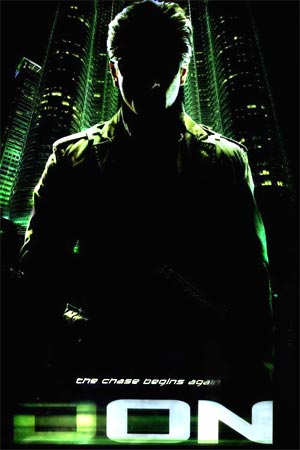
Yawn - The Review of Farhan Akhtar's Don

A few friends of mine informed me of their intentions to go along and see Farhan Akhtar's latest feature, Don. Having nothing better to do, I decided to accompany them and see what this new, upgraded version was all about. After watching the first few shots, where the new Don (Shahrukh Khan) pics up a Motorolla and croaks into it, "DON", i realised that perhaps a better alternative to vile away my time would have been to go to the neighbourhood canal and watch lackadaizical cows exctrete, rather than move into this thirty rupee hall and slaughter my senses. I really don't know what proposed Akhtar to remake this classic and I think neither does he ... Was he on marijuana or something, when this wierd hallucination gripped his senses? And just because Daddy-dearest collaborated on the original screenplay, i guess it gives you the liberty to massacre it. So Akhtar promised us to give a modern, pepped up and dynamic representation of the Chandra Barot Don, which coincidently had all that this was promising to offer.

So, where did the director go wrong? There must be something really disastrous in it, to make the maker of fantastic movies like Dil Chahta Hain and Lakshya look small. Well, that too is his own doing, since it was his bright idea of signing up Shahrukh Khan for the role of the modern Don. Now modernity is a very abstract term, and that will become clear to you after you finish seeing the movie - i.e. if you live to tell the tale, like I sadly have - because then you shall be caught in this dilemna, as to which of the Dons' was more modern! Was Amitabh Bachchan more modern, or Shahrukh Khan more antique (and I mean it in the Stone Age sense of the word)! He doesn't have the elan, the voice, the movements, the grace - in short he is a terrible Don. Stick to being Rahul or Raj, Mr. Khan, that's the way we love you! (I am NOT talking for myself)

After that comes the epic song, 'Khaike Paan Banaras Wala' and after Kishore Kumar, comes Udit Narayan. Now this chap always has a paan in his mouth, when he's singing romantic number, but here, where the paan was not optional but compulsory, there he decides to go moralistic! (Luckily I wrote moralistic there in stead of moronistic.) Even if you appreciate three pennies worth of your movie, you'll cry when you see this debacle on screen! Lucifer help you people!

See, the list like this is mammoth - Arjun Rampal for Pran, Om Puri as a god-knows who, Kareena Kapoor as Helen, Farhan Akhtar for Chandra Barot, I could make a three volume epic here! But I shall refrain .... Rather, on the other hand, let me try to provide a little relief to the already tormented director. Yes, surprising as it is, Don has a few plus points too. Though they are majorly outnumbered as compared to the flaws, they are positives none the less .....

Priyanka Chopra - hot, sexy, wicked seductress, eyeball popping diva! The shot in her in the pink gown will remain with viewers till the day they die. Words can't describe her!

Boman Irani - Iftekaar saab must be smirking from up there in the sky as he sees Mr. Irani effortlessly slip into his shoes. DCP De Silva's character is given a new impetus and elan as Boman Irani transcends the time barrier and breathes a new vitality into one of the central characters in the movie! Way to go Mr. Irani, you are the best!!

Also, if one sees the way the movie has been shot, its true that it is no great work, but we shouldn't complain, as many hollywood flicks have been represented in the same, sleazy way! So if we don't make a face then, we shouldn't do the same for a director from India. We should leave these neo-colonist viewpoints out of the world of Indian cinema, but if initiated into the reels, we shouldn't smurk!

The Final Verdict - AVOID it like the PLAGUE!!!!

Sunday, October 22, 2006

Black - So is the movie!

There are many incentives for a film-maker, specially one like Sanjay Leela Bhansali, to go into a project which marks his departure from the regular fare of monotonous, epic-grandeurish movies that he has made till date, to a songless, seemingly-realistic fare, that plans to convey a message on a very serious topic of discussion. He wants to prove to the world that he has what it takes to deliver on a more aesthetic, 'arty' level of magnificence that is lacking in most directors of the times. He believes himself to be at par with perhaps Guru Dutt or Balraj Sahni, or maybe even a Raj Kapoor. So what does he do after making non-sense like Hum Dil De Chuke Sanam and even great rubbish like Devdas? He goes and makes something which is a mix of the two - he goes and makes Black!

One aspect of art-house cinema, that is firmly embedded in the minds of the current 'trying to go new-wave' directors is that art films need to be boring, slow and accutely didactic. After all the movie is meant to give a message, to make the viewers think of a subject in newer light ... So what if Shyam Benegal made Ankur, he probably meant to give a message! Sanjay L Bhansali now grabs on to his "warriors of darkness" and tries to say something about them. It is the concentration of the message that gets into him so badly, that he obscures it completely within the reels of the movie. He remembers the self-flouted doctrines of pace (or the lack of it) of the film that he ventures into making it melodramatic. He tries to fill us with pathos and agony at the sight of his characters and he tries to forcefully enter into the audience's hearts to make them get up and take notice - and that is where he fails.

Black deals little with the situation of the deaf, blind and mute population of our country, but forcusses primarily on a deaf, blind and mute girl. It deals with her predicament, her sense of belonging in the world of perfectly functioning people. It deals with her struggle for existense, her never-say-die attitude, her optimism and her "teacher". But nowhere does it speak for the deaf, the dumb or the mute. Every event in her life is made into a gargantuan struggle before able bodies and thereby making her success all the more glorifying.

The seeds of melodrama are sown right from the begining, when the girl's mother revolts against her husband's decision to put her in a special school. I ask, what is so wrong in that? Isn't it the most wise thing to do in such a situation? Her mother's indiosyncratic manouverisms only end up throwing a spanner in her life! And if Bhansali didn't want this drudgery of melodrama to be inflicted on his viewers, he should have made the girl come from a destitute background, whereby her struggle wouldn't have been optional, but incidental. However, if he had done that, how could he fit in the "teacher" in his scheme of things?

Bhansali has merely applied the tools of an art film, but due to his lack of expertise in the matter, what has come out as the final product is anything but the idealist outcome he could have hoped for. In this context, I cannot help mention another movie that was released recently, dealing with the predicament of the third-sex in India. The movie, Navrasa by Santosh Sivan brilliantly captures the hopelessness of a 13 year old girl's uncle, who actually harbours the sentiments of being a woman. It does start of like Black does, but that is where the comparison ends. Instead of going away from a world of similar people, Navrasa goes right into it. Blending reality with myth, Sivan spins magic around the life of enuchs in India and essentially, never makes us feel any pity for them. The audience feels proud that they have created a world of their own. The audience joins them, rather than shower them with tears from the front of the curtain. That is the power of good cinema.

What makes Black a delight to watch are the performances. The young girl, Mitchelle, played by Ayesha Kapoor, is a powerhouse performance. Her eyes, her movements, her body-language, makes you believe that she really is what she is meant to be. Maybe Rani Mukherjee doesn't invoke much prowess in her skills, mainly due to the over-shadowing performace of young Kapoor, but it's true that no one in the Indian film industry could have done what she did. Shehnaaz Patel feels very significant as the lost, hopeless mother of a blind, deaf and mute girl and Dhritiman Chatterjee fits in beautifully as the pragmatic, yet loving father. And finally, the movie belongs to Amitabh Bachchan. At the age of 62, this man is a moving magician (incidently, that's what he is in the movie too, a "magician"). His nuances, his dialogues, his energy levels just fill you with awe. There is perhaps no actor in the world who could have done what he did, at this age too.

Black's significance and power lies in its performace and in its cinematography. Ravi K Chandran makes magnificient use of the predominant colour symbol in the movie and tries to create binary opposites without his camera getting preachy like the director.

Lets hope Sanjay L Bhansali returns to his earlier rubbish in his forthcoming Bajirao Mastani. At least there we can sleep it off in the cool confines of the theatre, rather than try to be awake, hoping that as promised, somewhere in the movie Bhansali will make things turn to something spectacular, to something worth watching.

[PS. There is one thing that I forgot to add, he has one more thing which goes to the film's success as the box-office - a stupid and equally melodramatic audience, who couldn't stop crying at this total hoch-poch, at this NONSENSE ...]

Saturday, October 21, 2006


Unpretentious Pretence

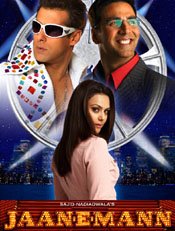
When you walk out of Sirish Kunder's Jaan-e-mann, you immediately go back to the opening credit titles and seeth in anger, when you remember having read 'Story - Sirish Kunder'. You feel that did someone really write a story for this bioscope? Did he have something to say? Was there any definite progression in this attempt, irrespective of the narrative being linear or not? And yet you missed it? And then you think, that did this movie (I won't call it a story) having anything new to perform? All that you did see were bits and parts of Gene Kelley's immortal Singin' in the Rain and Nikhil Advani's never-born Kal Ho Naa Ho. Then you turn around and ask me what my verdict is? is this movie worth the price of admission that you paid for, or is it just another bad investment?

If you want to see a quasi-Yash Chopra Kabhi Kabhi or a maybe a new-age Sangam, you are barking up the wrong tree. Taking a cue from his wife, Sirish Kunder lays out his cards within the first five minutes of the movie and that also includes a two-minute title card. Jaan-e-mann, intendedly has no sense nor was it meant to. Full of madness and dream-sequences and seemingly-realistic flashbacks, with the present hovering around the past, the chord of this movie lies in its sequnces, in its moments. Every episode is so well crafted and magically imposed on the audience that you for once do not get the inkling to leave your seat and go home! You never really do focus on the story, though it goes on, without you having to forcfully rely on it. The fare is rather stereo-typed and monotonous, but the effect and touches are innovative!


In addition to it, you get to see a new-improved Salman Khan, who does the same things with newer elan. The walk is the same, the dancing routines are the same, the expressions are the same and so is the body language, but it is a Salman Khan that you have never seen before! Its a Salman Khan that you like and love, a Salman Khan that you can idolize. Though Salman is the lead hero in the movie, the film belongs to Akshay Kumar. he guffowes, laughs, cries and behaves like someone you only associate as the college nerd - and yet he carries you away! The film just rests on his shoulders and he makes sure that the movie does not fall off anywhere. Priety Zinta fails in comparison to her co-actors, but she isn't bad. Its just that like the others, she isn't different, isn't new.

This Diwali, if you want to make your troubles seem lighter, without actually receiving a sermon on how to do that, go watch Jaan-e-Mann. You'll feel better!

Sunday, August 20, 2006


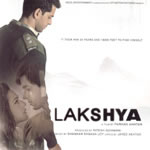
Lakshya - Mission Accomplished

His Dil Chahta Hain had created ripples in the Indian film industry, with an unusual script and an even more unusual plot. Some will question that what did the movie have? Others will say everything! Dil Chahta Hain contained in itself all the aspects of a typical hindi film, but it was so differently told that you were not bothered to make any connections. You just enjoyed it in its wholeness.

Farhan Akhtar, the golden boy of the Indian film industry disappeared after that. He was said to be looking for something completely different from his earlier offering, perhaps to show the audiences that he could handle different genres in the same medium. He was so hell bent on producing a stark variation that his father, Javed Akhtar came out of his screen-writing retirement to pen a war story for him, a story of war that had been shown many times before on Indian celluloid, but perhaps seldom potrayed to realistic perfection.

The story of Lakshya, the movie that was finally made is indeed very simple. The Kargil war of 1999 that it dealt with was incidental. It was never a war movie; it was a humanistic movie of an aimless individual who finally finds his 'lakshya' or aim in life. Progressing through a partial flashback from the present, Lakshya unfolds before us the life of Karan Shergill (Hrithik Roshan), aimless and confused. He wants to do everything, yet is too lazy to even put on his hot water apparatus to have a bath. Then comes a friend who has hopes of joining a 'dashing' Indian army. Karan immediately applies and is even asked to appear for the test. An irrate father (Boman Irani) is furious. Ego clashes appear and Karan bounces into the Army!

Now, everyone knows that the army is not a adventure zone and you can make that out when Karan escapes from the IMA. Romila (Priety Zinta) is absolutely crestfallen on hearing that and leaves him for good. What then changes him, as the screenplay tells us, is not consciousness, but again, his ego. It hurts him when she leaves him, he is humiliated. An interesting thing to be noted in this regard, is the dual perception of the word ego. Earlier, it was an ego which forced him to sit for the IMA exam because his father was furious. Now his ego deciphers the difference between his past and his future, his general incapability to take oncourse to a path his has chosen and a mission to go the full journey.


Karan is back and is now more disciplined and hard working. A collage of his training routine and his zeal is sufficient enough to tell us that, with Shankar Mahadevan crooning in the background. So, what happens next? He passes his course and is appointed lieutanant of the Indian Army. He earns his vacation after a posting under the command of Colonel Damle (Amitabh Bachchan). He returns home to see Romila engaged to someone else. Even as he gets over it, Pakistani infantry cause a breach of trust and cross the border to secure empty Indian checkposts. All army officials are called back and Karan Shergill, the boy who said "Main Aisa Kyun Hoon" (Why am I so incapable) return as a man to the firing line. Due to the advantagious position of the Pakistani infiltrators, thousands of Indian lives are lost. Col. Damle is forced to initiate an impossible mission to capture his designated peak and Karan Shergill completes the journey, he single handedly unfurls the tri-colour after taking possession of the outpost.

Brilliantly told and shown, Lakshya tells the story of a boy into a man, a man who knows what he is to do and how to do it and in a nutshell, do it. Farhan Akhtar consolidates his position as the Indian film industy's new powerhouse by perhaps (and this is only my view) surpassing his earlier Dil Chahta Hain. That movie was just a sequence of events, this is a message. Javed Akhtar cannot be talked of as a subsidiary in this article. His screenplay and dialogues leaves you spellbound. Take for instance the scene where Karan is taken to the border for the first time. He sees the Pakistani checkpost and exclaims that he always knew that he was an Indian, but this was the first time that he actually felt it. Absolutely stunning, it replaces with realism the utopian principle of a globe without borders. He brings out moments and characters that we can connect with, including the protagnist, Karan Shergill.

Speaking of whom, Hrithik Roshan absolutely delivers to the T. He too replaces his dancing image with an image who can portay anything. In Lakshya he plays a character, rather than the usual Hindi film conception of 'being yourself'. Karan is everything that Hrithik is not and that is what makes the character real and believable. You laugh at his earlier antics and you stand up and applaud, perhaps even cry, with Karan hoisting the indian flag on the peak. That speaks of Hrithik Roshan, actor and superstar.

Priety Zinta too matches up to Hrithik in perhaps the only half-baked character in the film. Her hairstlyles change, but she remains Romila Dutt right to the very end. She complements Hrithik throughout the movie, even in scenes that she is missing from, thereby playing the role of the significant other. Amitabh Bachchan looks like the about-to-retire CO, but his performance cannot be faulted. His eyes contain the misery that he must have seen over the years, in different wars and yet they flash genuine moments of bravado in his outfit's capabilities and his stigma. Hardly could anyone else do justice to Colonel Sunil Damle.

On the technical front, Christopher Popp's cinematography, his choice of angles and stock usage takes you into the world of the characters and potrays the various stages that they go through. This is perhaps one of the few moments in Indian cinema where you are transported into the world of the characters. Shankar-Ehsaan-Loy score songs that stand out even in seclusion from the screen and the background score haunts like that of perhaps Vangelis or Theodarkis. The simple and monotonous scores keep coming back to make you feel the rush of blood through your veins.

In all the movie is a remarkable effort at signifying its message. And like the message it contains, it goes all out to reach its destination. Mission Accomplished.